

Artificial intelligence is becoming a major part of healthcare transformation in Saudi Arabia. From virtual consultations and intelligent diagnostics to automated hospital workflows and personalized patient engagement, AI is helping healthcare organizations deliver faster, more connected, and more efficient services.
This shift aligns with Saudi Vision 2030, which places digital transformation, preventive care, accessibility, and service quality at the center of the Kingdom’s healthcare strategy. For hospitals, clinics, health-tech startups, insurers, and investors, the opportunity is no longer limited to experimenting with AI. The focus is now on building secure, scalable, and clinically useful AI healthcare platforms for the Saudi healthcare ecosystem.
This guide explores AI in Saudi healthcare, including platform development, key use cases, estimated costs, major challenges, and the features businesses should consider before investing in an AI-powered healthcare solution.
Why AI in Saudi Healthcare Is Growing Rapidly
Saudi Arabia has invested heavily in digital health infrastructure. Telemedicine, electronic health records, digital patient services, health data integration, and virtual care have created a strong foundation for artificial intelligence.
AI adds another layer of intelligence to this ecosystem. Instead of simply storing or displaying healthcare information, AI-powered systems can analyze data, identify patterns, automate repetitive processes, and support better decisions.
The Saudi Ministry of Health continues to expand virtual healthcare and AI-supported digital services under the Health Sector Transformation Program linked to Saudi Vision 2030, making AI healthcare platform development in Saudi Arabia increasingly relevant for both public and private healthcare organizations.
Also Read - How to Build an AI-Powered Mobile App: Strategy, Features, and Cost
What Is an AI-Powered Healthcare Platform?
An AI-powered healthcare platform is a digital system that combines healthcare workflows with technologies such as machine learning, natural language processing, predictive analytics, computer vision, and generative AI.
A patient-facing platform may include AI chat support, appointment scheduling, remote monitoring, and personalized reminders. A hospital-focused solution may support clinical decisions, medical imaging, staff scheduling, or workflow automation.
The strongest platforms use AI to solve a defined healthcare problem while keeping clinicians, patients, security, and regulatory requirements at the center.
Top Use Cases of AI in Saudi Healthcare
1. AI-Assisted Diagnosis and Clinical Decision Support
AI can analyze laboratory results, patient history, imaging data, and risk factors to support clinical decision-making. It should act as a support layer rather than replace qualified professionals, helping clinicians prioritize cases and identify potential risks.
For healthcare organizations handling large numbers of patients, such capabilities can help professionals process information faster while maintaining human oversight over important medical decisions.
2. Medical Imaging and Computer Vision
Computer vision can support analysis of X-rays, CT scans, MRIs, retinal images, and other medical imagery. For hospitals and diagnostic centers, these tools may reduce review time and flag high-priority cases.
As healthcare facilities generate increasing amounts of imaging data, AI-based analysis can become an important tool for assisting radiologists and improving diagnostic workflows.
3. Virtual Care and AI Health Assistants
Virtual care is already important in Saudi Arabia’s digital health environment. AI assistants can enhance it by answering common questions, guiding patients through services, sending medication reminders, collecting pre-consultation information, and helping users understand basic health information.
When connected to approved workflows, AI assistants can reduce pressure on support teams and improve patient engagement around the clock.
Saudi Arabia’s expanding virtual-care ecosystem demonstrates how digital services can complement traditional healthcare delivery. The Ministry of Health reported that the Sehhaty ecosystem exceeded 31 million users in 2025, while Seha Virtual Hospital has become a major component of nationwide virtual care.
4. Predictive Analytics and Preventive Care
AI can help healthcare organizations move from reactive treatment toward preventive care. Predictive models can analyze patient information to identify people at higher risk of complications, readmission, or certain conditions.
These insights can support earlier interventions, targeted follow-ups, and improved chronic disease management.
Preventive healthcare is particularly relevant to Saudi Arabia’s broader healthcare transformation, where improving population health and identifying risks earlier are becoming important priorities.
5. Hospital Operations Automation
AI can also streamline administrative and operational tasks. Common applications include appointment optimization, staffing forecasts, billing support, inventory planning, claim processing, patient-flow management, and automated documentation.
Reducing manual workload can improve efficiency while allowing clinical teams to focus more on patient care. For large hospitals and healthcare groups, even small efficiency improvements across thousands of daily processes can create meaningful operational value.
6. Remote Patient Monitoring
AI-enabled remote monitoring platforms can analyze data from connected medical devices and wearables. They may track heart rate, blood pressure, glucose levels, oxygen saturation, activity, and other health indicators.
If unusual patterns appear, the platform can generate alerts based on predefined clinical rules or AI models, helping care teams monitor patients beyond hospital walls.
Remote monitoring can be particularly valuable for chronic disease management, elderly care, post-treatment monitoring, and patients who live far from specialist healthcare facilities.
Also Read - Why Riyadh is Becoming the AI Innovation Hub of the Middle East
Essential Features of an AI Healthcare Platform
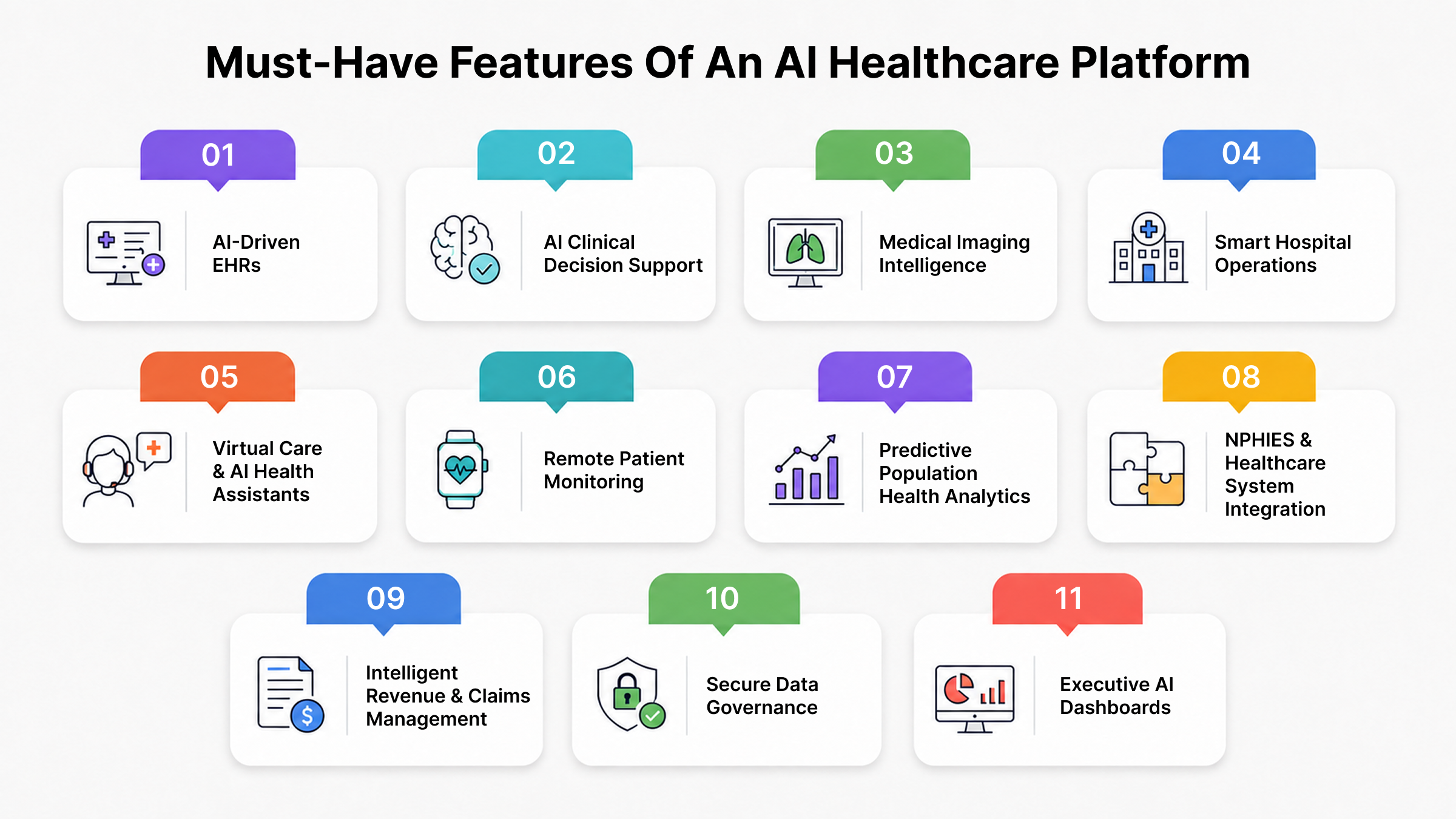
Most AI healthcare solutions in Saudi Arabia should prioritize usability, interoperability, intelligence, and security.
Core features can include secure authentication, patient and clinician profiles, appointment management, teleconsultation, electronic health record integration, AI-powered assistance, analytics dashboards, notifications, Arabic and English support, role-based access, audit logs, consent management, and secure API integrations.
Arabic-language capability deserves particular attention. A healthcare platform designed for Saudi Arabia should not treat Arabic as an afterthought. Its terminology, user experience, accessibility, and AI interactions should be tested with local users and healthcare professionals.
Interoperability is equally important. AI functionality becomes far more valuable when a platform can securely communicate with hospital information systems, laboratory systems, electronic medical records, insurance platforms, and approved third-party services.
AI Healthcare Platform Development Process in Saudi Arabia
Building a healthcare platform requires a structured development approach.
First, define the clinical or operational problem. Identify who will use the platform, what decisions it will support, what data it needs, and how success will be measured.
Next, complete product discovery and compliance planning. Map patient journeys, integrations, security requirements, data flows, and applicable Saudi regulations.
The development team can then create the UX/UI, architecture, backend, APIs, interfaces, and healthcare-system integrations.
The AI layer should be validated against its intended use case. Accuracy, bias, explainability, and reliability directly affect trust and, in some cases, clinical outcomes.
Before launch, the platform should undergo security, performance, usability, and AI validation testing. A controlled pilot can help identify technical, clinical, or user-experience issues before wider deployment.
How Much Does AI Healthcare Platform Development Cost in Saudi Arabia?
The cost of AI healthcare platform development in Saudi Arabia varies based on complexity, integrations, AI capabilities, security requirements, and whether the solution is built from scratch.
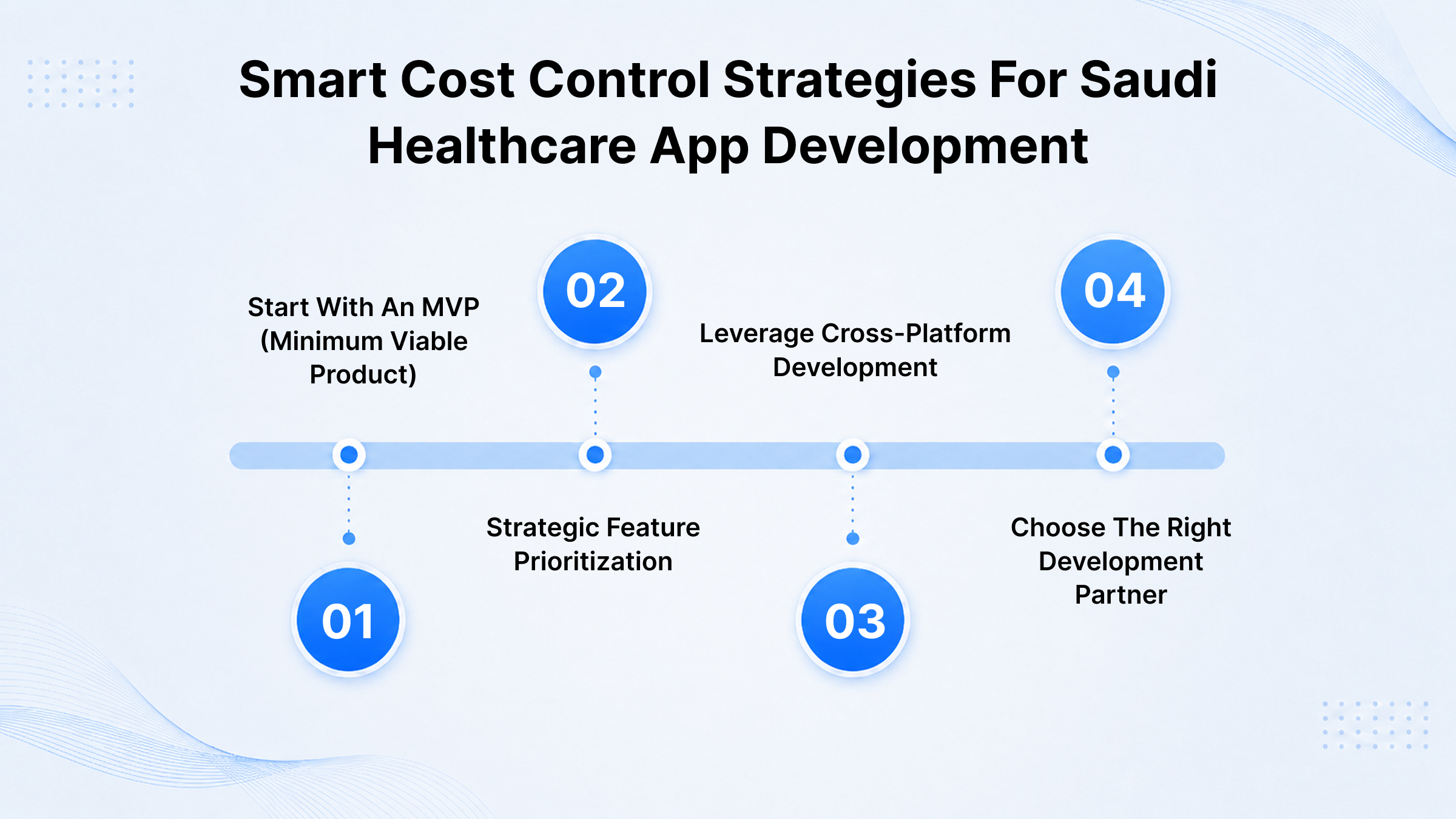
As a broad planning estimate, a focused MVP may cost around SAR 300,000 to SAR 600,000. A more advanced platform with custom AI, telehealth, analytics, multiple integrations, and enterprise security may range from approximately SAR 600,000 to SAR 1.5 million.
Large-scale hospital, insurer, or multi-provider healthcare platforms can exceed SAR 1.5 million, depending on the project scope and technical requirements.
These figures are indicative, not fixed market prices. Medical imaging, complex EHR integrations, real-time device data, multilingual AI, and advanced cybersecurity can raise the budget. Organizations should also plan for cloud infrastructure, maintenance, monitoring, security updates, and model improvement.
Starting with an MVP can help businesses validate the healthcare use case before committing to a larger technology investment.
Key Challenges of AI Adoption in Saudi Healthcare
Healthcare data privacy is one of the biggest challenges. Saudi Arabia’s Personal Data Protection Law (PDPL) applies to personal data processing, while health data is subject to additional protections. Healthcare organizations therefore need strong controls around data access, processing, storage, security, and third-party vendors. Saudi regulations specifically require organizational, technical, and administrative measures for protecting health data.
Interoperability is another major issue. Healthcare data may sit across hospital systems, laboratory platforms, insurance systems, medical devices, and legacy applications. An AI platform is only as useful as the quality and accessibility of the data supporting it.
AI accuracy and bias also require close attention. Models trained on unsuitable or non-representative datasets may perform poorly for local populations or clinical environments. Human oversight, testing, monitoring, and clear escalation processes are essential.
User adoption can also determine whether a technically strong solution succeeds. Doctors need systems that fit existing workflows, while patients need simple, accessible experiences that build trust.
The Future of AI in Saudi Healthcare
The future of artificial intelligence in Saudi healthcare is likely to be driven by deeper integration rather than isolated AI tools. AI will increasingly work alongside virtual care, digital health records, connected devices, hospital systems, and preventive health programs.
For businesses entering this market, the strongest opportunities will come from solving specific healthcare problems with measurable outcomes. A successful AI platform should improve access, efficiency, clinical support, patient engagement, or operational performance while meeting Saudi requirements for privacy and security.
Saudi Arabia has the digital-health momentum and national transformation agenda to support continued innovation. Organizations that build secure, interoperable, and locally relevant AI solutions can position themselves for a healthcare ecosystem that is becoming increasingly intelligent and data-driven.
Also Read - Why Smart Enterprises Choose Dedicated Power BI Development Services

Conclusion
AI in Saudi healthcare is moving from experimentation toward real-world adoption. Healthcare providers and technology companies are exploring AI for diagnostics, virtual care, predictive analytics, remote monitoring, administrative automation, and personalized patient experiences.
However, building a successful AI-powered healthcare platform in Saudi Arabia requires more than choosing the latest AI model. Businesses need a clear use case, reliable data, strong cybersecurity, Saudi regulatory compliance, healthcare interoperability, careful AI validation, and a user experience designed for Arabic and English audiences.
With the right development strategy, AI can help healthcare organizations support the goals of Saudi Vision 2030 while creating faster, smarter, and more accessible healthcare experiences across the Kingdom. As a trusted AI development company in Riyadh, Mobcoder helps healthcare organizations design and build secure, scalable AI-powered platforms aligned with local market needs.
Frequently Asked Questions
1. What is AI in healthcare?
AI in healthcare refers to the use of technologies such as machine learning, natural language processing, predictive analytics, computer vision, and generative AI to improve clinical, administrative, and patient-care processes. It can support diagnostics, automate workflows, analyze health data, and improve patient engagement.
2. How is AI being used in Saudi Arabia’s healthcare sector?
AI in Saudi healthcare is being used for virtual care, medical imaging, clinical decision support, remote patient monitoring, hospital automation, predictive analytics, patient assistance, and healthcare data analysis. These initiatives support the Kingdom’s broader digital transformation under Saudi Vision 2030.
3. What are the main benefits of AI healthcare platforms in Saudi Arabia?
The major benefits include faster healthcare delivery, improved operational efficiency, better patient engagement, enhanced clinical decision support, reduced administrative workload, personalized care, and greater access to healthcare services across different regions.
4. How much does it cost to develop an AI healthcare platform in Saudi Arabia?
The cost of AI healthcare platform development in Saudi Arabia can range from approximately SAR 300,000 to SAR 1.5 million or more, depending on platform complexity, AI features, integrations, cybersecurity requirements, and regulatory needs. Enterprise healthcare platforms with advanced AI capabilities can require a larger investment.
5. What features should an AI-powered healthcare platform include?
An AI-powered healthcare platform may include secure user authentication, patient profiles, appointment scheduling, telemedicine, AI chat assistance, electronic health record integration, predictive analytics, remote monitoring, notifications, Arabic and English support, role-based access, and administrative dashboards.
6. Is AI healthcare software required to comply with Saudi data privacy regulations?
Yes. Healthcare platforms that process personal or health-related data in Saudi Arabia must consider applicable Saudi data protection requirements, including the Personal Data Protection Law (PDPL). Strong security, access controls, consent management, and appropriate data-governance practices are essential.
7. Can AI replace doctors and healthcare professionals?
AI is primarily designed to support healthcare professionals rather than replace them. It can analyze large amounts of information, automate repetitive processes, and provide decision-support insights, while qualified medical professionals remain responsible for clinical judgment and patient care.
8. How long does it take to develop an AI healthcare platform?
Development timelines vary according to project scope. A focused MVP may take several months, while a complex enterprise healthcare platform with custom AI models, multiple integrations, and advanced security features can take significantly longer to design, test, validate, and deploy.
9. What are the biggest challenges of adopting AI in Saudi healthcare?
Key challenges include healthcare data privacy, cybersecurity, integration with legacy systems, AI accuracy, bias, regulatory compliance, data quality, user adoption, and ensuring that AI models perform reliably within local clinical environments.
10. What is the future of AI in Saudi healthcare?
The future of AI in Saudi healthcare is expected to include greater use of predictive care, intelligent virtual health services, connected medical devices, automated hospital operations, personalized treatment support, and AI-assisted diagnostics. As Saudi Arabia continues its healthcare digital transformation, AI is likely to become increasingly integrated into everyday healthcare delivery.