


We’ve seen long reddit threads from flutter app developers going crazy about the app architecture. Some are stuck on the scaling part, some are confused if this framework is feasible for social media apps.
The Flutter framework has come a long way in 2026. With AI-native development tools and well-tested architecture patterns, there is no reason for this app architecture to be a hurdle.
As a leading flutter app development company, we have curated an easy to understand resource for you to learn how to build scalable apps using flutter with best practices.
Why Architecture Matter for Flutter App Developers
To simply put, app architecture is like the foundation of developing apps which are easily maintained, scaled, and are user-friendly. Without proper architecture, an app can easily go into “code chaos,” which makes it hard for developers to implement new features and resolve bugs.
The following are the reasons why we emphasize so much on good architecture in flutter app development:
Also Read - Profitable Custom App Development for Startups: A Complete Guide
Maintainable code means less technical debt
When the architecture is sound, bugs are contained, and patches won’t break other areas, you won’t need to hunt down 50 files to update one aspect.
Scalable apps mean your app will function even in large-scale production
With a larger user base and more features, modular architecture means your app won’t fail. Adding payment gateways or other integrations won’t require complete overhauls.
Onboarding new app developers becomes streamlined
New flutter app developers can quickly understand /features/authentication and grasp the codebase immediately. Onboarding from weeks to days becomes possible.
Leadership receives predictable delivery
Apps with good architecture mean accurate sprint planning. Technical leadership can promise roadmaps with confidence because good architecture patterns mean no surprise in the development phase.
Also read: The Future of Cross-Platform Development: Flutter vs. React Native
Common Mistakes in Flutter App Architecture
One of the pitfalls of Flutter app development is using a monolithic architecture. Everything is in main.dart or a few giant files. This kind of architecture is perfectly fine for a tutorial or learning project but is completely unworkable in a real-world application.
- Mixing UI and business logic results in untestable code. When build() methods are full of API calls and validation rules, it becomes impossible to test business logic without rendering widgets.
- Disregarding state management best practices leads to setState() hell and unexpected rebuilds. Passing callbacks through five levels of widgets quickly becomes a maintenance nightmare.
- Lack of a modular architecture leads to code duplication in features. When payment logic is duplicated in three places, it means that to fix one bug, you have to update three different files.
Let’s understand the whole scenario with an example. There is an e-commerce app where product-fetching logic is hard-coded into UI widgets, checkout state is stored in global variables, and API models are defined inline throughout the codebase. When a new payment provider is added, it suddenly breaks 15 files in 3 directories.
As a reliable flutter app development company, we are not saying this is hypothetically possible, it actually happens when you build flutter without architectural design.
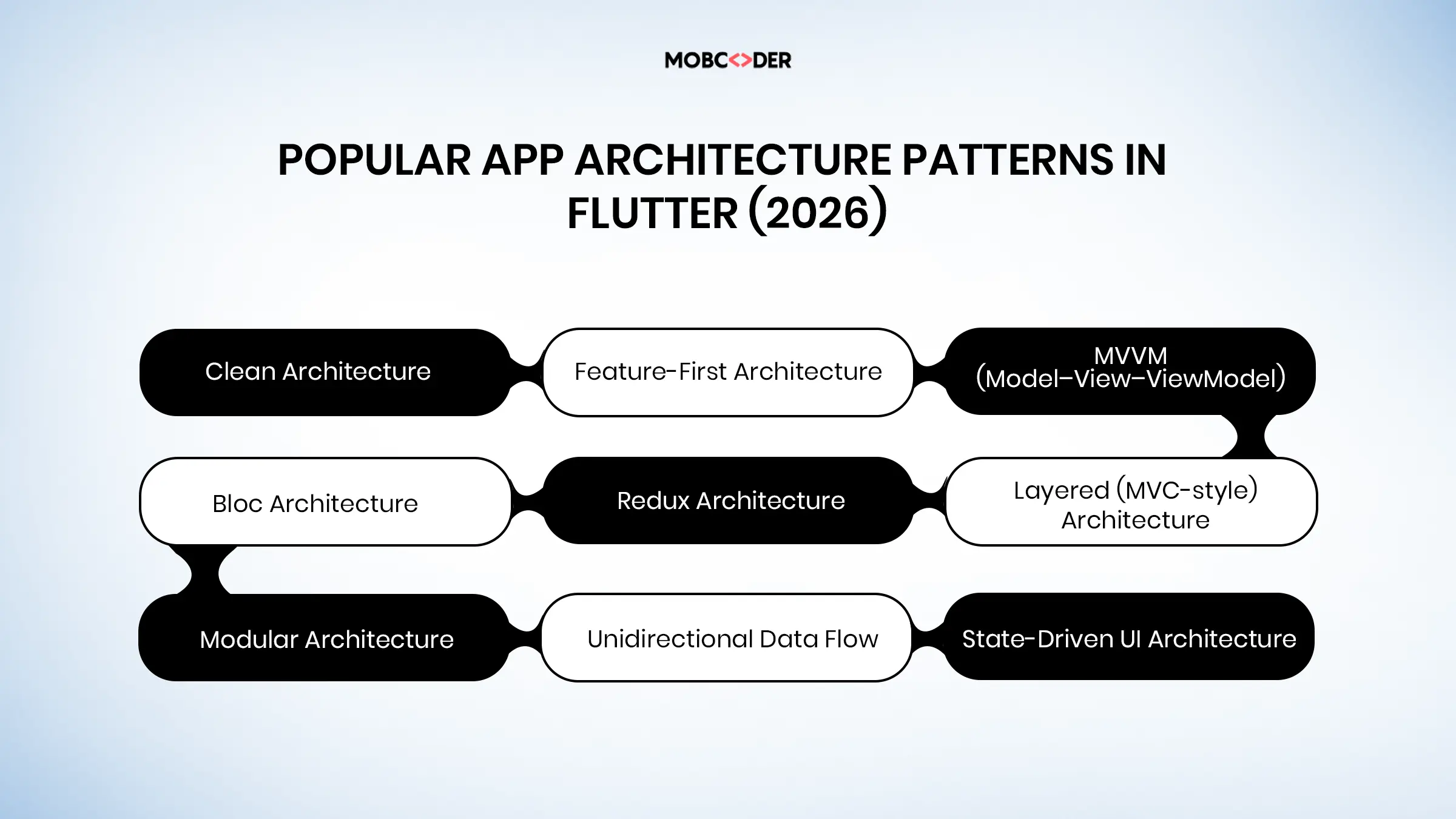
Top Flutter App Architecture Patterns 2026
In our flutter app development services we use all the popular app architecture, some of which are:
BLoC (Business Logic Component)
BLoC maintains a strict separation between UI and business logic through streams and events.
- Some of the strengths are: Predictable state changes, easily testable, strongly typed. Suitable for complex enterprise applications and large-scale production.
- Few areas of improvements are: Steep learning curve, too much boilerplate code for simple functionality.
- Best suited for: BFSI, Fintech apps, B2B or enterprise-level applications
Provider / Riverpod
Riverpod is experiencing huge popularity in 2026 due to its compile-time safety and minimal boilerplate code.
- Why it’s popular: It resolves runtime errors in Provider, offers automatic disposal, and comes with dependency injection.
MVVM (Model-View-ViewModel)
MVVM maintains a separation between UI and data layers without the complexity of reactive streams.
Best suited for: Teams familiar with native mobile development, simple CRUD applications.
Clean Architecture
Clean Architecture maintains a strict separation between layers: presentation layer, domain layer, and data layer with strict dependency rules.
- Architecture: Domain layer (business logic, entities), data layer (API, database), presentation layer (UI, state management). Dependencies are only inward.
- Best suited for: Large applications (50k+ lines of code), multiple teams, and long-term projects that require platform independence.
Structuring Real-World Flutter Apps
Here's an example of production-grade folder structure:
lib/
├── core/
│   ├── config/
│   ├── constants/
│   ├── network/
│   ├── theme/
│   └── utils/
├── features/
│   ├── authentication/
│   │   ├── data/
│   │   │   ├── models/
│   │   │   ├── repositories/
│   │   │   └── datasources/
│   │   ├── domain/
│   │   │   ├── entities/
│   │   │   └── usecases/
│   │   └── presentation/
│   │       ├── providers/
│   │       ├── pages/
│   │       └── widgets/
│   ├── products/
│   └── checkout/
├── shared/
│   └── widgets/
└── main.dart- /core contains app-wide infrastructure: configuration, theming, networking, utilities.
- /features implements feature-based modularity. Each feature is self-contained with data, domain, and presentation layers. Teams work on separate features without merge conflicts.
- /shared holds reusable widgets and models used across features.
E-Commerce App Structure example
features/
├── products/
│   ├── domain/entities/product.dart
│   ├── data/repositories/product_repository_impl.dart
│   └── presentation/providers/products_provider.dart
├── cart/
│   ├── domain/entities/cart_item.dart
│   └── presentation/pages/cart_page.dart
└── checkout/
    ├── data/datasources/payment_gateway.dart
    └── presentation/pages/checkout_page.dart
Each feature manages its own state. Cart imports Product from products/domain but doesn't depend on products' presentation layer. This isolation makes scaling possible.
Backend Integration
Handle all external communication in the data layer:
class ProductRemoteDataSource {
  final ApiClient apiClient;

  Future<List<ProductModel>> getProducts() async {
    final response = await apiClient.get('/products');
    return (response.data as List)
        .map((json) => ProductModel.fromJson(json))
        .toList();
  }
}
This makes swapping REST for GraphQL or adding caching trivial without touching business logic.
Also Read - Super Apps in 2026: How Brands Can Build All-in-One Digital Ecosystems
Tools and Practices That Make Architecture Easier
Code generation eliminates boilerplate
Flutter apps use code generation to keep the codebase clean and organized:
- freezed generates immutable data models with value equality and copy functionality
- json_serializable generates JSON parsing code
- build_runner keeps generated code in sync
These tools remove boilerplate code while ensuring predictable and testable data models.
Testing safeguards the architecture
Various types of tests detect different issues:
- Unit tests check business logic fast
- Widget tests check UI behavior independently
- Integration tests confirm core user flows function end-to-end
A robust test suite allows refactoring the app safely as it grows.
Automation enforces best practices
Continuous integration analyzes and tests code on every commit, ensuring no broken or badly structured code makes it into the codebase. Lint rules detect architectural issues early, such as UI code leaking into the domain.
AI-first tools speed up development
AI-first tools can automatically generate data models from API descriptions, recommend refactoring, and point out architectural issues during code review.
Business Value of App Architecture
As a Flutter app development company, we rely on architecture to determine how reliably an app can scale, evolve, and be maintained over time. Strong structure reduces technical debt, accelerates delivery, and keeps teams productive as complexity grows.
- Predictable timelines: Well-architected apps enable accurate estimates. Adding features is measured in days, not surprise refactoring weeks.
- Faster onboarding: New developers start contributing in days, not months when architecture is clear.
- Lower long-term costs: Steady velocity as apps scale versus velocity decay from technical debt.
Trend Predictions for Flutter App Developers in 2026
- Code generation using AI is production-ready in 2026. It can automatically generate scaffolding code that is architecture-compliant based on natural language descriptions.
- Micro-frontends and feature modules allow developers to work on features independently and deploy them as packages.
- Cross-platform integration (Web, Desktop, Embedded) needs architecture that isolates platform code from business logic.
- Reactive and adaptive architecture with Riverpod and asynchronous state management is becoming the norm for managing complex data flows.
Also Read - Mobile App Security in 2026: Key Trends to Look Out For
Key Takeaways
App architecture has a direct influence on maintainability, scalability, and the productivity of the development team. A business owner should select patterns depending on the size of the flutter app development team and the complexity of the app they want to build. Riverpod for most apps, BLoC for enterprise apps, and Clean Architecture for long-term large-scale apps.
With the right approach and architecture, flutter app developers can build an app which is scalable, irrespective of the industry you’re in.
Need help building a full-fledged flutter app? Contact us and get affordable flutter app development services.
FAQs
1. What is the best architecture for Flutter apps?
It depends on complexity. Riverpod works for most apps. BLoC suits enterprise projects. Clean Architecture is best for 50k+ line apps with multiple teams.
2. Should I use BLoC or Provider in 2026?
Use Riverpod (Provider's successor) for most projects—it's safer and simpler. Use BLoC when you need strict patterns and maximum testability in enterprise environments.
3. How do I structure a Flutter app for team collaboration?
Use feature-based folders (/features/authentication, /features/products). Each feature is self-contained with its own data, domain, and presentation layers. Teams work independently without merge conflicts.